
Bedevaart
In de voetsporen van de apostelen
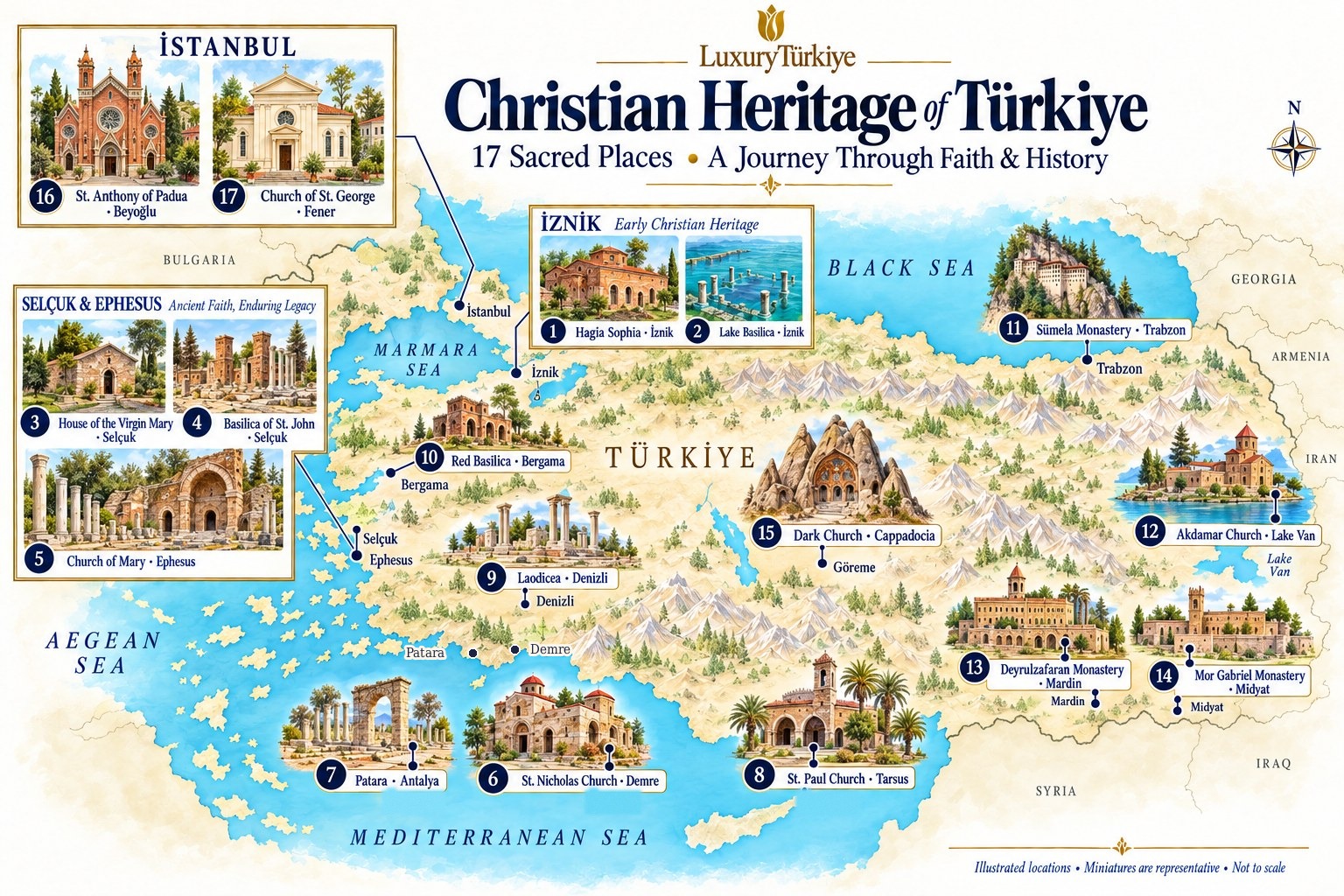
Türkiye, in bijbelse tijden Klein-Azië genoemd, is een land met een diep christelijk erfgoed. Hier liggen veel heilige plaatsen waar de apostelen predikten, de eerste christelijke gemeenschappen opbloeiden en belangrijke gebeurtenissen uit de kerkgeschiedenis plaatsvonden. Onze christelijke bedevaarten zijn een diepe reis door het geloof, de geschiedenis en de cultuur van het vroege christendom.
- Duur
- Op maat, 5–12 dagen
- Groep
- Privé · gids & Mercedes V-Klasse voor 4 tot 6 gasten · luxe Sprinter voor groepen tot 12
Belangrijke bedevaartsplaatsen
- Huis van de Maagd MariaBij Efeze geldt dit heiligdom als het laatste huis van de Maagd Maria. Erkend door de Katholieke Kerk en bezocht door paus Paulus VI, Johannes Paulus II en Benedictus XVI, is het een vredige plek voor gebed en bezinning.
- De zeven gemeenten uit OpenbaringGenoemd in het boek Openbaring, behoorden deze zeven gemeenten tot de eerste christelijke gemeenschappen:
- Efeze: geprezen om haar volharding, gemaand terug te keren naar haar eerste liefde
- Smyrna (İzmir): de vervolgde gemeente, aangemoedigd trouw te blijven
- Pergamum: gewaarschuwd voor valse leer
- Thyatira: bekend om liefde en dienstbaarheid, gewaarschuwd voor compromissen
- Sardes: opgeroepen te ontwaken uit de geestelijke dood
- Filadelfia: de trouwe gemeente, geprezen om haar standvastigheid
- Laodicea: de lauwe gemeente, opgeroepen tot bekering
- Sint-Pieterskerk, AntiochiëIn Antakya, het oude Antiochië, geldt deze grotkerk als een van de eerste kerken ter wereld. Petrus zou hier gepredikt hebben, en in Antiochië werden de volgelingen van Christus voor het eerst christenen genoemd (Hand. 11:26).
- Hagia Sophia, IstanbulIn de 6e eeuw gebouwd als Byzantijnse kerk, was de Hagia Sophia lang de grootste kathedraal ter wereld en meer dan 900 jaar een centrum van het orthodoxe christendom. Haar mozaïeken en geschiedenis maken haar onmisbaar voor pelgrims.
- Basiliek van Sint-Jan, EfezeIn Selçuk geldt de basiliek als rustplaats van de apostel Johannes, die het evangelie van Johannes en het boek Openbaring schreef. Pelgrims bezoeken de ruïnes om zijn nalatenschap te eren.
- Ararat · De ark van NoachDe Bijbel (Gen. 8:4) vertelt dat de ark van Noach na de zondvloed op de bergen van Ararat tot rust kwam. In het oosten van Türkiye blijft de Ağrı een betekenisvolle plek voor christenen, een teken van geloof en van Gods belofte.
Waarom met ons reizen
- Een reis die het geloof verdiept: verdiep uw spirituele weg op plaatsen met grote bijbelse betekenis.
- Deskundige bijbelse gidsen die de Schrift tot leven brengen met historische en theologische inzichten.
- Comfortabel reizen en verblijven: hotels van hoge kwaliteit, vlot vervoer en professionele service voor een zorgeloze bedevaart.
- Programma's op maat voor reizigers, kerkgroepen en geloofsgemeenschappen.
Goed om te weten
Begin aan een reis van geloof. Wandel in de voetsporen van de apostelen, verdiep uw geloof en ervaar de tijdloze schoonheid van de plaatsen waar het christendom wortel schoot. Neem contact op en wij plannen uw bedevaart op maat naar Türkiye.
Places of Faith

Read more
Why it matters
The largest Catholic church in İstanbul and the heart of the city's Catholic life, served by Franciscan friars. The future Pope John XXIII preached here when he was the Vatican's envoy in Türkiye, and the city still calls him 'the Turkish Pope'.
A short history
- 1725: Italian Franciscans found the first church of St. Anthony in Pera.
- 1906–1912: the present church is built in Venetian neo-Gothic style by the architect Giulio Mongeri.
- 1935–1944: Angelo Roncalli, later Pope John XXIII, serves in İstanbul as apostolic delegate.
- Today: Masses are celebrated here in several languages.
What you will see
A red-brick façade set back from İstiklal Avenue behind a quiet courtyard, a statue of Pope John XXIII, and a tall, light interior with stained glass.
Goed om te weten
In the middle of İstiklal Avenue, an easy walk from Taksim or the Galata Tower. A calm stop on a busy shopping street.
Read more
Why it matters
The patriarchal cathedral of the Ecumenical Patriarchate of Constantinople, the spiritual centre of some 300 million Orthodox Christians worldwide.
A short history
- 1601: St. George in Fener becomes the cathedral of the Patriarchate.
- 1720: the church is rebuilt after a fire, in the simple form you see today.
- 1821: Patriarch Gregory V is hanged at the main gate; the gate has stayed closed ever since.
- 2004: Pope John Paul II returns relics of St. John Chrysostom and St. Gregory the Theologian to this church.
What you will see
A modest exterior and a richly gilded interior: the carved iconostasis, the patriarchal throne, the relics of saints, and a column fragment venerated as part of the Column of the Flagellation.
Goed om te weten
A working church: dress modestly and keep silence during services. Easily combined with the historic streets of Fener and Balat on the Golden Horn.

Read more
Why it matters
In AD 787 this church hosted the Seventh Ecumenical Council, the last council recognised by both Catholic and Orthodox Churches. It restored the veneration of icons.
A short history
- 6th century: a large basilica stands at the heart of Byzantine Nicaea.
- 787: the Second Council of Nicaea meets here.
- 1331: after the Ottoman conquest of İznik it becomes the Orhan Mosque.
- 2011: after decades as a museum, it is again used as a mosque.
What you will see
A plain brick building in the centre of İznik, with traces of a Byzantine floor mosaic and a faded fresco of Christ with the Virgin Mary and St. John the Baptist.
Goed om te weten
Today an active mosque: visits are outside prayer times, with shoulders and knees covered and a headscarf for women. Easily combined with the Lake Basilica.

Read more
Why it matters
İznik is ancient Nicaea, where the First Ecumenical Council wrote the Nicene Creed in AD 325, still recited by Christians around the world. The basilica in the lake is thought to honour St. Neophytos, a young martyr of Nicaea.
A short history
- 303: St. Neophytos is martyred in Nicaea under Emperor Diocletian, according to tradition.
- 4th century: a basilica is built on the lakeshore; earthquakes later bring it below the water.
- 2014: aerial photographs reveal the walls a few metres from the shore.
- 28 November 2025: for the 1,700th anniversary of the Council of Nicaea, Pope Leo XIV and Ecumenical Patriarch Bartholomew pray together at the site.
What you will see
The outline of the church walls under clear, shallow water, seen from the shore, with the lake and hills of İznik around you.
Goed om te weten
The ruins are under water and best seen on calm, sunny days. About two hours by road from İstanbul, a good day trip with İznik's Hagia Sophia.

Read more
Why it matters
Christian tradition holds that St. John brought the Virgin Mary to Ephesus, and that she spent her last years in a small house on the hillside above the city. Today it is one of the most visited Marian shrines in the world, and Muslims also come to honour Maryam, the mother of Jesus.
A short history
- 1st century: the tradition places Mary in Ephesus with St. John.
- 1891: Lazarist priests from İzmir identify the ruined chapel on Bülbül Dağı, guided by the visions of the German nun Anne Catherine Emmerich.
- 1967, 1979 and 2006: Popes Paul VI, John Paul II and Benedict XVI pray at the shrine.
- Every 15 August: pilgrims gather here for the Feast of the Assumption.
What you will see
A small stone chapel rebuilt on old foundations, quiet among the pines; the spring below it, where pilgrims fill bottles of water; and the wishing wall, covered with ribbons and handwritten prayers.
Goed om te weten
Shoulders and knees covered inside the chapel, and silence is kept. A short, gentle walk from the car park. Easily combined with Ephesus and the Basilica of St. John on the same day.

Read more
Why it matters
St. John the Apostle is believed to have lived and died in Ephesus. This basilica stands over the place traditionally honoured as his tomb.
A short history
- 1st century: according to tradition, St. John lives and writes in Ephesus.
- 4th century: a first church is built over his tomb.
- 6th century: Emperor Justinian builds a great cross-shaped basilica with six domes.
- 14th century: the basilica falls into ruin after earthquakes; restoration of its columns and walls continues today.
What you will see
The marble slab marking the tomb of St. John, the baptistery, rows of restored columns, and wide views over Selçuk, the İsa Bey Mosque and the last column of the Temple of Artemis.
Goed om te weten
On Ayasuluk Hill in Selçuk, a few minutes from Ephesus. Little shade: morning or late afternoon is best in summer.

Read more
Why it matters
In AD 431 the Council of Ephesus met here and declared Mary 'Theotokos', the Mother of God, a defining moment for Christian faith.
A short history
- 2nd century: the building begins as a long Roman hall near the harbour.
- 4th century: it is turned into one of the first churches dedicated to the Virgin Mary.
- 431: the Third Ecumenical Council meets in Ephesus.
- Later centuries: the church is rebuilt and made smaller, and finally abandoned.
What you will see
The long nave of the church, its apse, and a well-preserved round baptistery with its immersion pool.
Goed om te weten
At the northern edge of Ephesus, away from the busy main streets, so many visitors miss it. Your guide includes it on request.

Read more
Why it matters
St. Nicholas was bishop of Myra in the 4th century. His kindness to the poor and to children made him one of the most loved saints of East and West, and the origin of Santa Claus.
A short history
- 4th century: Nicholas serves as bishop of Myra and is buried here.
- 8th century: the church is rebuilt after earthquakes and raids.
- 1087: Italian sailors take his relics to Bari, where they rest today.
- 19th century: the church is restored with Russian support.
What you will see
Byzantine frescoes, a marble floor in coloured patterns, and a carved sarcophagus traditionally linked to the saint. Nearby: the rock-cut tombs and theatre of ancient Myra.
Goed om te weten
In Demre, about two and a half hours from Antalya. Orthodox pilgrims gather here around his feast day on 6 December. Easily combined with Kaş and Kekova.

Read more
Why it matters
Patara is honoured as the birthplace of St. Nicholas, and St. Paul changed ships in its harbour on his way to Jerusalem (Acts 21:1–2).
A short history
- Lycian and Roman times: Patara is a leading port and the meeting place of the Lycian League.
- c. 270: St. Nicholas is born here, according to tradition.
- c. 57: St. Paul sails from Patara towards Phoenicia at the end of his third journey.
- Today: excavations have restored the Lycian assembly hall and the main colonnaded street.
What you will see
The restored Lycian assembly hall, the theatre, the colonnaded street, the lighthouse ruins, and one of the longest sandy beaches in Türkiye.
Goed om te weten
Little shade: bring a hat and water. The beach is a protected nesting site for sea turtles and closes in the evening. About 15 minutes from Kalkan.

Read more
Why it matters
Tarsus is the birthplace of St. Paul, 'a citizen of no mean city' (Acts 21:39). His journeys and letters carried Christianity across the Roman world.
A short history
- c. AD 5–10: Saul, later St. Paul, is born in Tarsus.
- 1st century: after his conversion he returns to Tarsus before his missionary journeys.
- 1862: the present church, dedicated to St. Paul, is built.
- Today: the church is a museum, where Christian groups may hold services by arrangement.
What you will see
A small church with ceiling paintings of the Evangelists, and nearby St. Paul's Well, where tradition places the house of his family, beside a stretch of Roman road.
Goed om te weten
Mass for groups needs prior arrangement, which we organise for you. Adana airport is about 40 minutes away.

Read more
Why it matters
Laodicea was one of the Seven Churches of the Book of Revelation, the church that was 'neither cold nor hot' (Revelation 3:14–22). St. Paul also mentions it in his Letter to the Colossians.
A short history
- 1st century: a Christian community grows in the city.
- c. 95: the Book of Revelation addresses the church of Laodicea.
- 4th century: one of the oldest known church buildings in Anatolia is built here.
- Since 2003: large excavations bring back streets, theatres and the early church.
What you will see
Long colonnaded streets, two theatres, temples, and the early Christian church with its baptistery and mosaics.
Goed om te weten
Ten minutes from Pamukkale, so the two are best seen on the same day. The site is large and open: comfortable shoes and water help.

Read more
Why it matters
Pergamon was home to one of the Seven Churches of Revelation, the city 'where Satan has his throne', and the place of the martyr Antipas (Revelation 2:12–17).
A short history
- 2nd century: under Emperor Hadrian a vast temple of red brick is built for the Egyptian gods.
- c. 95: the Book of Revelation addresses the church of Pergamon.
- 5th century: a church is built inside the temple.
- Today: restoration continues on the walls and towers.
What you will see
Massive red-brick walls, the round towers on each side, and the Selinus river flowing beneath the temple through ancient tunnels.
Goed om te weten
In the lower town of Bergama. Easily combined with the Acropolis of Pergamon and the Asklepion. About an hour and a half from İzmir.

Read more
Why it matters
One of the most dramatic places of pilgrimage in the Christian world: a Greek Orthodox monastery dedicated to the Virgin Mary, built into a cliff above a forest valley.
A short history
- 4th century: according to tradition, two Athenian monks found the monastery with an icon of the Virgin attributed to St. Luke.
- 14th century: the emperors of Trebizond enlarge and protect it.
- 1923: the monks leave the monastery.
- 2010: the Divine Liturgy is celebrated here again on 15 August; after restoration the monastery reopens in 2020.
What you will see
The rock church covered with frescoes, inside and out, the buildings clinging to the cliff about 1,200 metres above sea level, and the view over the Altındere Valley.
Goed om te weten
The way up is a walk with stairs and slopes: comfortable shoes are a must. About an hour from Trabzon. Pilgrims gather here for the Dormition liturgy on 15 August.

Read more
Why it matters
The Armenian Church of the Holy Cross is a masterpiece of medieval Christian art. Its walls tell the stories of the Bible in stone.
A short history
- 915–921: the architect Manuel builds the church for King Gagik I of Vaspurakan.
- Centuries later: it serves as the seat of the Catholicos of Akdamar.
- 2005–2007: the church is restored and reopens as a museum.
- Since 2010: a Divine Liturgy is held here once a year.
What you will see
Exterior reliefs of Adam and Eve, Jonah and the whale, David and Goliath and many saints, frescoes inside, and Lake Van all around the island.
Goed om te weten
Reached by boat from Gevaş pier, about 20 minutes across the lake. Boats depend on the weather.

Read more
Why it matters
For almost eight centuries this was the seat of the Syriac Orthodox Patriarch. Monks still live here, and prayers are said in Syriac, close to the Aramaic language of Jesus.
A short history
- Late 5th century: the monastery is founded on the site of an ancient temple.
- 1160–1932: it is the seat of the Syriac Orthodox Patriarchate.
- Today: it remains a working monastery and the seat of the Metropolitan of Mardin.
What you will see
Honey-coloured stone courtyards, the main church with its old altar, the underground chamber of the earlier temple, and the tombs of the patriarchs.
Goed om te weten
A few kilometres outside Mardin. Visits are guided by the monastery; dress modestly. Best combined with old Mardin and Mor Gabriel.
Read more
Why it matters
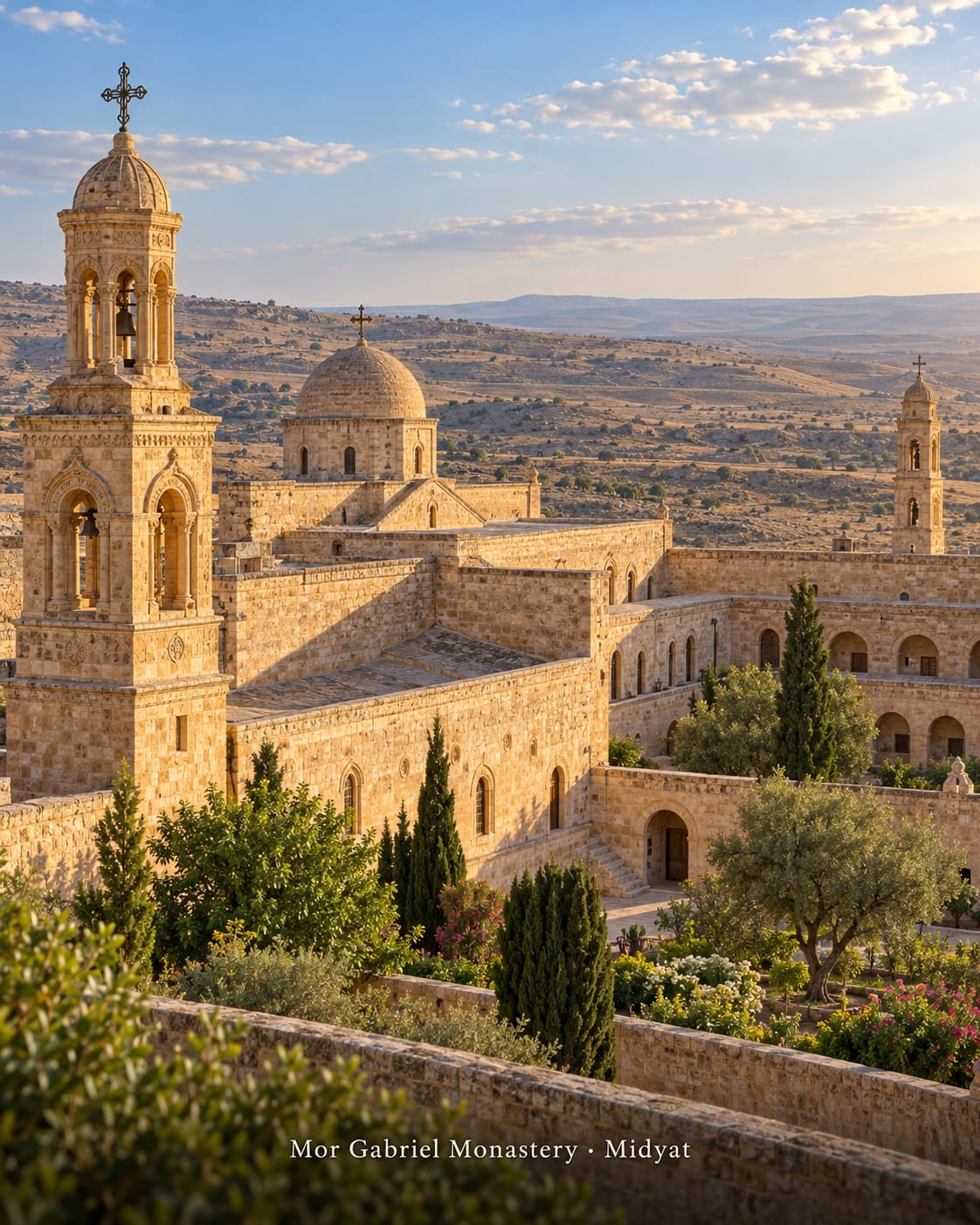
Founded in AD 397, Mor Gabriel is one of the oldest Christian monasteries still in use anywhere in the world, the spiritual heart of the Tur Abdin, 'the mountain of the servants of God'.
A short history
- 397: the monks Mor Shmuel and Mor Shemun found the monastery.
- 6th century: imperial support brings the main church and its mosaics.
- 7th century: it takes the name of Abbot Gabriel.
- Today: monks, nuns and students live here as the seat of the Metropolitan of Tur Abdin.
What you will see
The main church with 6th-century mosaics, the domed chapels, and the burial places of saints and monks.
Goed om te weten
A living monastery with set visiting times, confirmed when we plan your day; dress modestly. About 20 minutes from Midyat and an hour from Mardin.

Read more
Why it matters
Cappadocia was a cradle of Christian monasticism, home of the 4th-century Cappadocian Fathers. The Dark Church has some of the finest Byzantine frescoes in the region.
A short history
- 4th century: St. Basil the Great and the two St. Gregorys shape monastic life in Cappadocia.
- 11th century: monks carve the church into the rock and paint it.
- 2006: after many years of restoration, the church reopens to visitors.
What you will see
Vivid scenes of the life of Christ, from the Nativity to the Crucifixion, kept fresh by the little light that enters the church.
Goed om te weten
Inside the Göreme Open-Air Museum, with a separate ticket. Only a few visitors are allowed in at a time, and photographs are not permitted.